
I love showing new visitors our unusual church building – opening the heavy black door and hearing their comments of surprise at the unexpectedly large golden interior. The church looks so light and airy despite the heavy black brick walls, thanks to the predominance of light wood furniture and panelling.
The building was designed by the architects Robert Maguire (1931-2019) and Keith Murray (1929 to 2005), pioneers in post-war church design who combined the intellectual and architectural toughness of New Brutalism with the humanity and warmth of the Scandinavian tradition. Many of the design concepts they first championed in St Paul’s, Bow Common, London, were refined and re-expressed in the new All Saints, including the church in the round expression of ‘God with us’ rather than the distant sanctuary expressing ‘God transcendent and other’ of traditionally designed churches. Fortunately, the gutter downspouts within the walls of St Paul’s were designed out for All Saints, leaving us with the four large external concrete pillars instead.
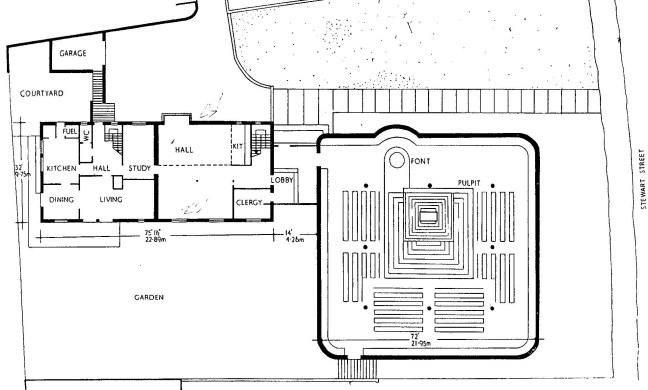
The architects’ remit was to design a church which would fit into a restricted site with relatively narrow frontage and would be built to a tight budget. It was to seat 350 people, and up to 450 on special occasions, but to be in scale for much smaller gatherings. Despite the modern design, the plans incorporated many traditional elements, including the font near the doorway into the church, and the baldacchino over the central altar. The church hall needed to be a place for real community activity, not a box with a little-used stage. It had to be suitable for small groups but also for big rowdy parties, and to include a small kitchen. The attached vicarage was to be a four-bedroomed house. Sole access would be maintained by the right of way through the alley from Rockwood Avenue.
The architects’ design was of a long building extending from the Stewart Street-facing church, through the church hall in the middle of the building, to the vicarage at the far end. It was built to building regulation standards of the 1960s. Materials included asbestos cement slates on bituminous roofing felt with half-inch polystyrene insulation. The party wall between the hall and the vicarage had 11 inch cavity brickwork but was not sound-proofed. The only toilet in the original plans was upstairs in the hall, to save costs. There was no car park.
In The Buildings of Cheshire by Pevsner and Hubbard, the new All Saints’ is described as: An exceptionally interesting church. Square plan with rounded corners, and with seating arranged around three sides of the altar. Font N.E. of the altar, with a segmental projection in the wall behind it. Pyramid roof punctuated by a vertical clerestory. Thanks to that listing, we still get visitors coming to our church, Pevsner in hand, wanting to see our unusual architecture.
Building began in 1964 and took less than two years. The new church was consecrated by the Bishop of Chester on 31st October 1965. A recording of the consecration service has been preserved on two 78 rpm records, which we have converted to MP3 files. You can listen to the recordings here.
 All Saints' Church