Blog

Looking Back: Celebrations at All Saints’

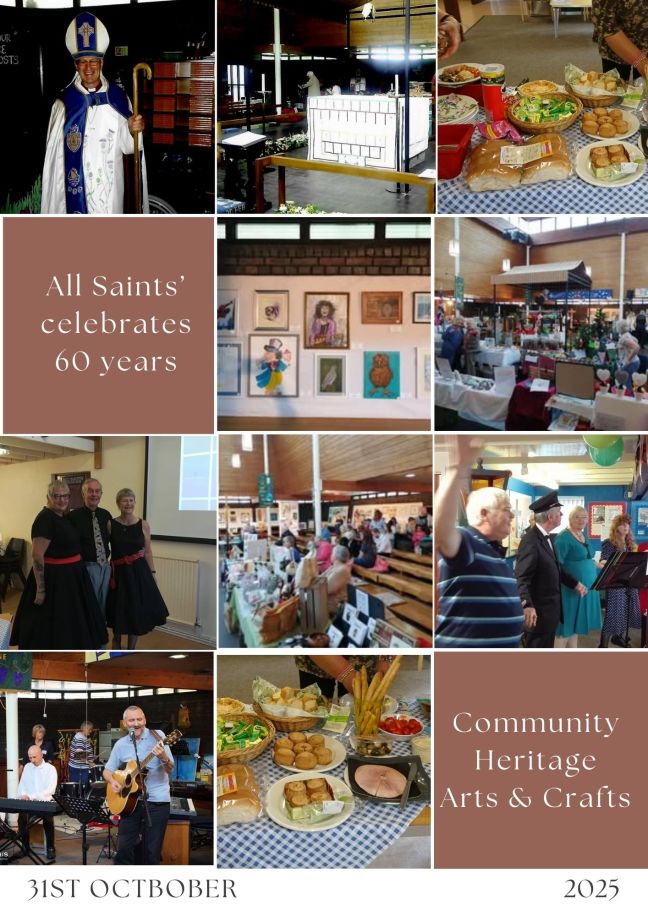
The community at All Saints’ Church in Crewe has celebrated many milestones over the sixty years since the consecration of the new building in 1965.

In 2005, the church held a Needlework and Flower Festival from Thursday 23rd to Sunday 26th June, to celebrate the church’s 40th birthday. This included a service led by Bishop Nigel of Stockport. Floral displays around the church represented the different seasons of the Christian calendar. The Rainbow Room had a wonderful display of needlework and embroidery. More displays and stalls were set up in the church hall, where refreshments were also available, and the back garden played host to a plant stall. With boards outside inviting people to come in, the event was a great success.

A new altar frontal was specially commissioned for the 40th anniversary. Agnes Monaghan and Revd Margaret Saville designed the frontal, which was formed from forty image squares embroidered by the more nimble-fingered members of the congregation, one square for each year. Helen Evans sewed the frontal together – a huge task. Those members of the congregation who (like myself) were not so handy with a needle and thread paid for the materials. The church still uses the altar frontal regularly as part of the seasonal textile changes supporting patterns of worship through the cycle of the church year.

Between 2009 and 2019, All Saints’ held the biennial ArtsFest on six occasions around its harvest weekend in early October. This event celebrated art and creativity in many different forms. The walls of the church were turned into an art gallery displaying pictures by local artists, with many paintings for sale. Three sides of the church housed craft stalls, while the fourth side became a music venue. Performers from local schools and writers’ groups, church members, musicians and local choirs provided entertainment from the time the doors opened each morning until they shut again each evening. In the church hall, people demonstrated different crafting skills in hands-on sessions on one side of the room, while a café occupied the other side, serving food and beverages all day. The event also featured the Harvest Festival service itself, where the congregation gave thanks for all God’s gifts – food, water, shelter, as well as the fruits of human creativity.

While All Saints’ doesn’t host such big events at present, the church still holds regular coffee mornings and afternoon teas to support charities like Macmillan’s. Some of these are themed, such as the WWII afternoon tea held in 2016 and the Rockabilly event in 2018. If you would like to come to the next one, look out for more details of All Saints’ upcoming social events its Facebook page and on this website.

All Saints’ next celebration is the 60th birthday service this weekend, on Sunday 2nd November with Bishop Julie. Do come and join us. Hope to see you there.
Looking Back: All Saints’ Parish Boundary Changes

In March 1970, the Diocese of Chester published the Report of the Bishops’ Commission on Crewe, reviewing the number of parishes and church buildings and changes in population in the town. Its terms of reference were: To assess the arrangements for the pastoral care of people in the central area of Crewe and to make recommendations. The working party shall not be inhibited from examining other parishes and related areas as they affect long term planning (p2).

St Paul with All Saints’ was by far the largest parish in Crewe with an estimated population in 1969 of 14200, similar in number to the 15757+ recorded in the 1931 census which had included the population of St Peter’s. Such a size of parish was considered to be quite as large as parishes run on traditional lines can conveniently be (p5). The next largest parish was St Michael Coppenhall with St Gabriel which had a population of about 13020 in 1969, up from 8089 in the 1931 census. While no recent parish population figures are available for All Saints’ with St Paul, our sister parish in our present combined benefice, St Andrew’s with St John’s reported in the latest parish profile as having a population of about 13000, up from the 1931 census figure of 9887 and the 1969 estimate of 11200, with more people moving from the centre of town to the suburbs.

The main recommendation in the 1970 report was for a central parish with a team ministry to be formed, covering Christ Church, St Paul with All Saints’, and St Peter’s, with a combined population of 20900. The report also suggested adding a portion of the parish of St Michael’s covering Sydney as that was more accessible from St Peter’s.

The team ministry suggestion of 1970 did not make it into practice. Thirty-six years after the report, the Church Commissioners’ Pastoral Scheme signed in December 2006 dissolved the benefice of Crewe All Saints and St Paul; and the benefice of Crewe Christ Church and St Peter; to create the new benefice of Crewe All Saints and Saint Paul with Saint Peter, with their parishes continuing to be distinct. A new benefice of Crewe Christ Church was also established, which subsequently joined St Andrew’s benefice. As a part of this change, the Christ Church vicarage was sold off and the vicarage at All Saints’ was kept. In December 2022, the Church Commissioners’ Pastoral Scheme created the new combined benefice of Crewe All Saints and Saint Paul with Saint Peter and Crewe Saint Andrew with Saint John the Baptist. The estimated population of the new combined parish is in the region of 21000, with expectations of further growth due to additional building in and around the southern part of Crewe. With changes in the way parish ministry operates, this super-parish is cared for by just one full-time and one part-time associate priest.

Looking Back: All Saints’ Consecration 31/10/1965

Towards the end of the Covid-19 lockdown, Roy Butler, Wendy Peacock and I formed a church work party. Besides tackling such jobs as preparing the church for the next quinquennial inspection and clearing the gutters and drains, we also sorted and filed twenty-plus years of crated documents which had been left in the upstairs office. Among these, we found two vinyl disc recordings of the Consecration Service held at All Saints on 31st October 1965. The discs had previously been owned by Ken Lawley, All Saints’ Choirmaster at that time.

When the recording plays, the listener is transported back to that era with its high church traditions and distinct accents. Though the condition of the discs is not of the best, I have managed to make a digital recording of much of the service and the address. You can access the recordings here.

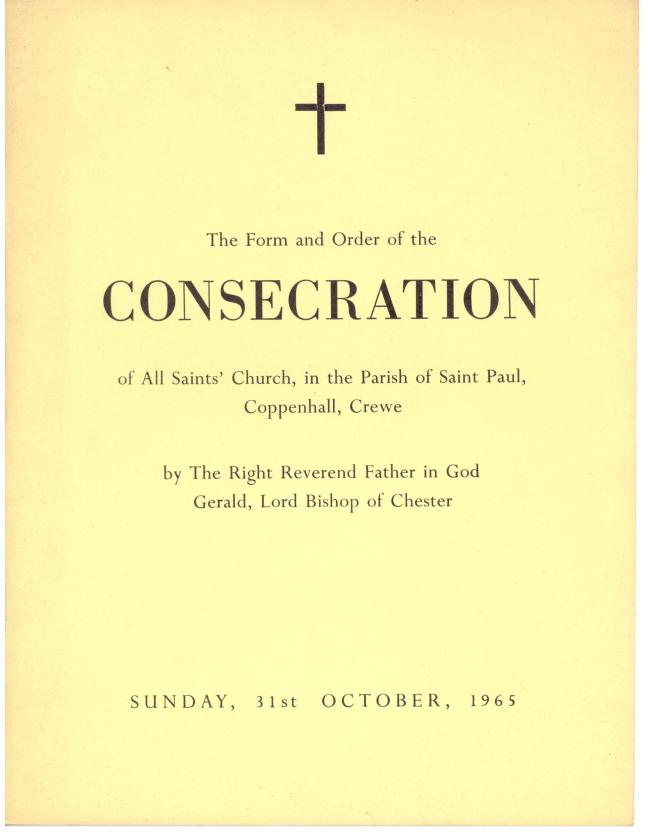
The Right Reverend Father in God Gerald, Lord Bishop of Chester officiated at the consecration. At 9.30 in the morning, the Bishop’s procession left the Vicarage and was met at the main door by the Churchwardens F Meakin and J Gibson, the Architect, representatives of the Building Contractor Bovis, the Rural Dean and the Archdeacon. During the procession, the choir and congregation who had already assembled in church, stood to sing Psalm 24: The Earth is the Lord’s and all that therein is.

The Bishop struck the door three times with his staff and led some responses before being admitted. All present then recited The Apostles Creed and knelt to pray with the Bishop in silence for the church and all who would worship there. Still kneeling, they sang Come, Holy Ghost, our souls inspire.

Following the Prayers of Consecration, the Bishop processed around the church to bless the key fixtures, led by the Crucifer and accompanied by some of the church officials. They visited the font, the entrance to the sanctuary, the pulpit, the priest’s stall, and the altar, while the choir sang appropriate verses of the hymn We love Thy Place, O God. This was followed by the Act of Consecration itself. The Bishop dressed the altar as the congregation sang, Once, only once, and once for all. He read the Sentence of Consecration and marked the Consecration Stone in the Sanctuary to show that the church had been consecrated. The congregation responded by singing Praise God from whom all blessings flow to the tune Old Hundredth.

The Parish Communion followed the consecration, during which the following hymns were sung:

            Praise the Lord, ye heavens adore Him

            Christ is our corner-stone

            Just as I am, without one plea

            Bread of Heav’n, on Thee we feed

            At the name of Jesus

Several copies of the order of service for the Consecration are on file in our church office. Do ask if you would like to see one.

Looking Back: From All Saints’ Archives

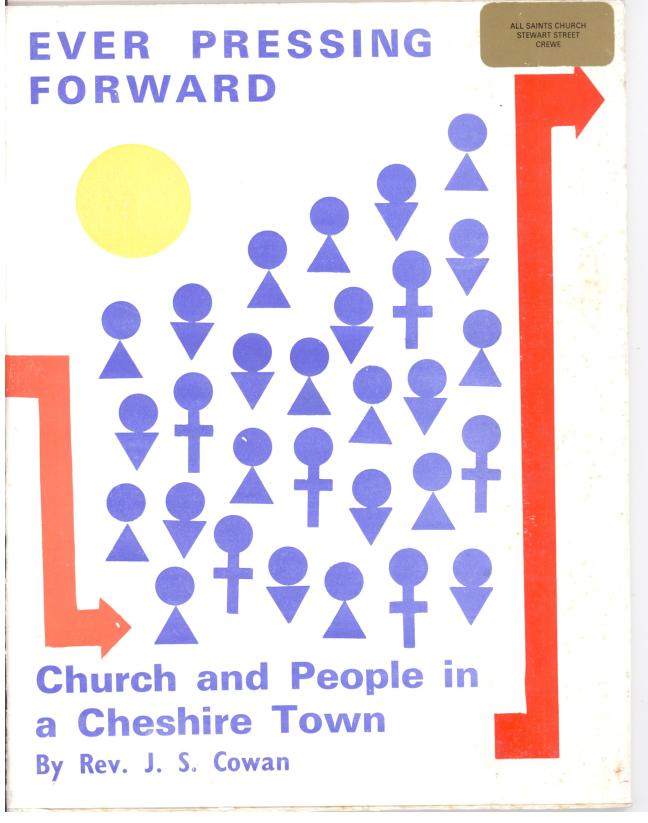
All Saints’ archives contain several publications from the 1960s and 1970s. St. Paul’s and All Saints featured in the epilogue of the report Ever Pressing Forward – Church and People in a Cheshire Town by Rev. J.S. Cowan. This document was a study in mission produced for the Centenary of St. Paul’s, Coppenhall, 1969 and for the Crewe, Nantwich and District Local Christian Council. The following is an extract from that report.

St Paul’s and All Saints : a decade.

What has been significant in the last ten years or so? Perhaps it is too early to say. The most obvious thing is that St Paul’s has been thoroughly restored and the new All Saints’ built in Stewart Street. It is equally obvious that neither of these things could have been done without Planned Giving or Stewardship. At least we have overcome one of the weaknesses to which John Cowan pointed on pages 12-13. The new church has been hailed by the Architects’ Journal as ‘one of the most significant churches built in any country since the war’,

But buildings are only a base : on the one hand for worship. We are rightly told on page 13 that ‘It is relatively easy to provide buildings for worship – It is much harder to build a worshipping community to use them’…. On the other hand buildings, if used rightly, may operate as a base for mission. Does the significance of the last decade lie in preparation for mission?

Perhaps the answer will be found only in what we now make of what has been given to us. The answer or choice is still in the making. One of the more hopeful signs is the tentative participation by the laity in a greater missionary consciousness. At least the Parochial Church Council and others now meet specifically to consider different aspects of mission by our Parish Consultations. A good number of parishioners act as Messengers to improve the church’s contact with people. These are small seedlings for the future: will they grow or will they wither? We have still much further to go in clearing the decks for real missionary enterprise as required in the present day.

We may risk one guess: our future lies in relation to others. This should be obvious from the fact that most of the area around St. Paul’s is likely to be demolished in the next few years. Other signs of the times may be seen in the movement towards Anglican Methodist unity; in the present discussion on ‘Partners in Ministry’ a report which envisages a ministry of greater partnership or team. Even at this moment a commission is being convened by the Bishops top consider the future relationship of parishes and churches in the area so that they may be more effective in mission.

Looking Back: The New Church Design

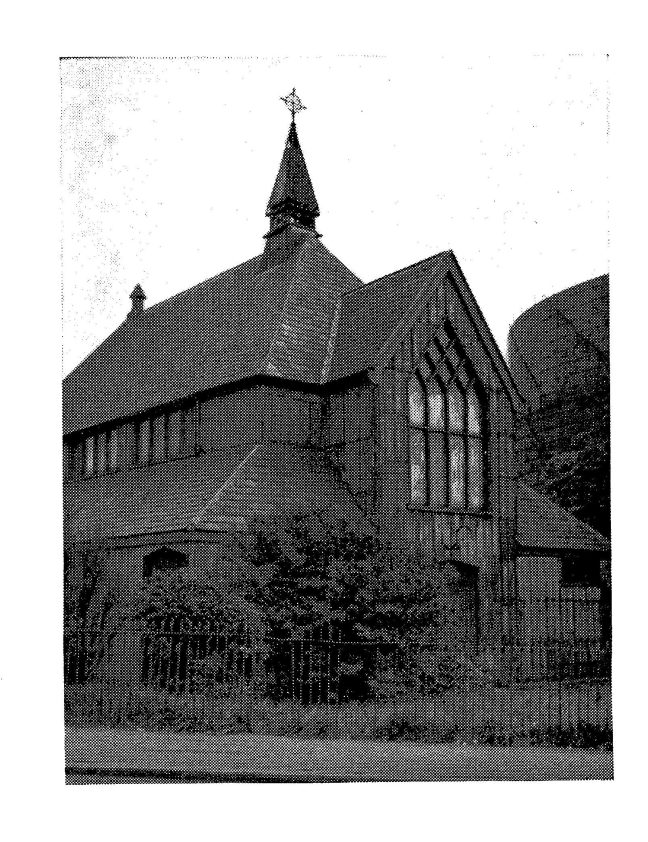
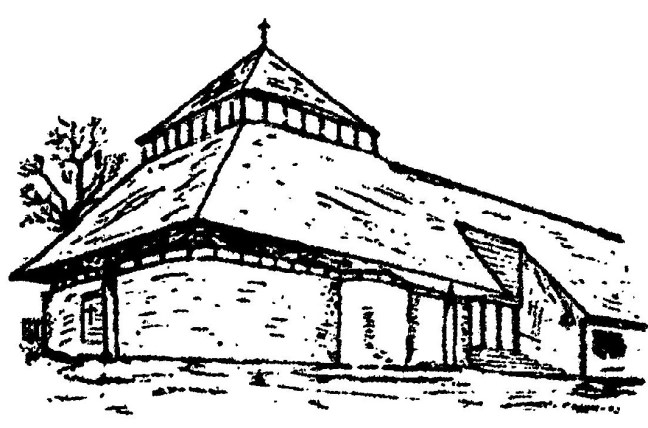
I love showing new visitors our unusual church building – opening the heavy black door and hearing their comments of surprise at the unexpectedly large golden interior. The church looks so light and airy despite the heavy black brick walls, thanks to the predominance of light wood furniture and panelling.

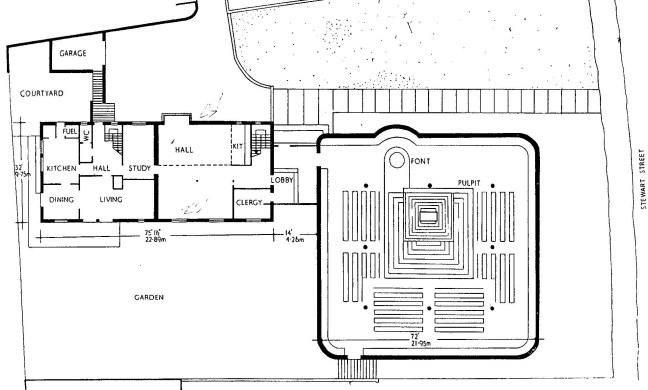
The building was designed by the architects Robert Maguire (1931-2019) and Keith Murray (1929 to 2005), pioneers in post-war church design who combined the intellectual and architectural toughness of New Brutalism with the humanity and warmth of the Scandinavian tradition. Many of the design concepts they first championed in St Paul’s, Bow Common, London, were refined and re-expressed in the new All Saints, including the church in the round expression of ‘God with us’ rather than the distant sanctuary expressing ‘God transcendent and other’ of traditionally designed churches. Fortunately, the gutter downspouts within the walls of St Paul’s were designed out for All Saints, leaving us with the four large external concrete pillars instead.

The architects’ remit was to design a church which would fit into a restricted site with relatively narrow frontage and would be built to a tight budget. It was to seat 350 people, and up to 450 on special occasions, but to be in scale for much smaller gatherings. Despite the modern design, the plans incorporated many traditional elements, including the font near the doorway into the church, and the baldacchino over the central altar. The church hall needed to be a place for real community activity, not a box with a little-used stage. It had to be suitable for small groups but also for big rowdy parties, and to include a small kitchen. The attached vicarage was to be a four-bedroomed house. Sole access would be maintained by the right of way through the alley from Rockwood Avenue.

The architects’ design was of a long building extending from the Stewart Street-facing church, through the church hall in the middle of the building, to the vicarage at the far end. It was built to building regulation standards of the 1960s. Materials included asbestos cement slates on bituminous roofing felt with half-inch polystyrene insulation. The party wall between the hall and the vicarage had 11 inch cavity brickwork but was not sound-proofed. The only toilet in the original plans was upstairs in the hall, to save costs. There was no car park.

In The Buildings of Cheshire by Pevsner and Hubbard, the new All Saints’ is described as: An exceptionally interesting church. Square plan with rounded corners, and with seating arranged around three sides of the altar. Font N.E. of the altar, with a segmental projection in the wall behind it. Pyramid roof punctuated by a vertical clerestory. Thanks to that listing, we still get visitors coming to our church, Pevsner in hand, wanting to see our unusual architecture.

Building began in 1964 and took less than two years. The new church was consecrated by the Bishop of Chester on 31st October 1965. A recording of the consecration service has been preserved on two 78 rpm records, which we have converted to MP3 files. You can listen to the recordings here.

Looking Back – The Cost of Building All Saints’

This year, All Saints’ celebrates the 60th anniversary of its consecration. To mark this, our parish magazine featured a short series of articles about the history of our church and hall.

In October 1959, the churches of St Paul and its daughter church of All Saints, published the 16 page document Review Your Parish in Action. Revd. Ronald Tostevin was vicar at the time. He had introduced the practice of Christian Stewardship in the two churches the previous year, after British Railways ceased supporting the Church when it was nationalised in 1953. He now called upon the congregations to give financial support for a temporary church building beside All Saints’ church hall, and for a new church building which was being planned to replace both.

The new All Saints’ church and hall were needed to replace the two churches, which were in a very poor condition. St Paul’s had serious problems with dry rot which required immediate restoration. The original old All Saints’ tin church building had lasted ‘long beyond its allotted span’ and was ‘quite obviously beyond hope of repair’ according to Revd. Tostevin, but did have a new lease of life after being dismantled when it was relocated to the corner of Stewart Street and Collins Street. The cost of the temporary building beside the church hall was estimated to be in the region of £1,200, and the new church in excess of £10,000 (in a time when the total annual running expenses of the two churches was under £2,000).

It is not easy to interpret church accounts at that time, as the two churches had one PCC and one set of accounts. An account sheet covering the period from 1959 to 1970, shows that the amount raised by the PCC was significantly more than that. According to other contemporary accounts, the total costs of building and equipping the new church and hall was £48,385, though elsewhere the higher figure of £51,000 has been recorded. The Diocese gave a grant of £31,000 towards this, leaving the PCC to raise at least a further £17,385.

In addition to this, the PCC had to take out a loan to build the Vicarage which is attached to All Saints’ church hall. The original amount of the loan was £10,593, some of which was paid off following the sale of the old Vicarage. Between 1967 and 1970, the PCC paid £2321 in repayments, and the loan balance at the end of December 1970 stood at £5603.

This must have been a great financial commitment for the congregations of the two churches at that time. My own take home pay in early 1970s London was about £10 per week. We owe it to those who went before us, to honour their commitment and keep All Saints’ going for another 60 years.